

November 30, A Day Full of Stories
Every day on the calendar carries a rich history, made up of triumphs, decisive battles, and bold beginnings. November 30 is no exception, having served as the backdrop for events that have had a lasting impact on global politics, science, and culture. It is a day when humanity first looked at space with new eyes, when a future major figure of World War II was born, and when nations gained their footing. In this detailed, we will thoroughly explore the historical milestones set on November 30, going beyond simple dates to explain why these moments still matter today. From the birth of modern astronomy to Caribbean independence, prepare for a fascinating journey through time.
Geopolitical Milestones: Wars, Peace, and the Birth of Nations
November 30 is particularly rich in events that have redrawn world maps, from conflicts to international recognition. In 1966, the island nation of Barbados officially gained its independence from the United Kingdom. This event is a powerful symbol of the wave of decolonization that swept the globe after World War II, allowing Barbados to take control of its domestic and international affairs, laying the groundwork for its development as a major tourist destination and financial center. Centuries earlier, on November 30, 1782, a decisive step toward ending the American Revolutionary War (1775-1783) was taken when representatives of the United States and Great Britain signed a preliminary peace agreement in Paris. This accord was the fundamental basis for the official Treaty of Paris signed the following year (September 1783), which recognized the independence of the United States and defined its borders, thus becoming one of the founding documents of the modern American nation. However, the date also marks the beginning of conflict: November 30, 1939, saw the start of the Winter War when the Soviet Union invaded Finland, just weeks after the start of World War II in Europe. Although the Red Army was massively superior in numbers, the invasion was delayed by fierce and heroic Finnish resistance. Even though Finland was eventually forced to sign a peace treaty in March 1940, its resilience revealed the initial weaknesses of the Red Army—crucial intelligence that Hitler would note for his own invasion of the USSR in 1941.
Births and Deaths: Figures Who Marked Their Time
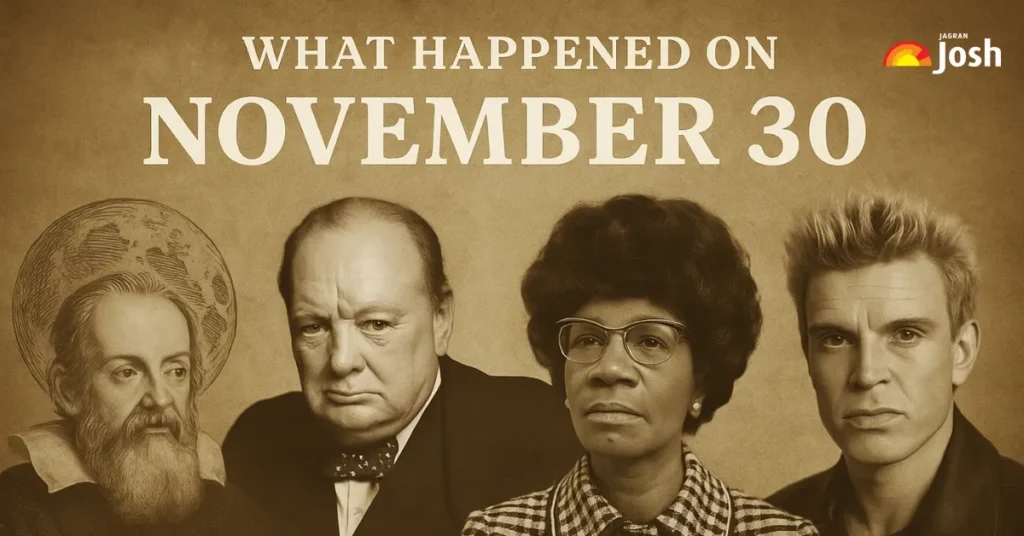
November 30 is intimately linked to the lives of personalities whose influence has spanned centuries. Born on November 30, 1874, Winston Churchill is one of the most important political figures of the 20th century. He is best known for being the British Prime Minister during World War II (starting in 1940). His unwavering leadership and powerful rhetoric, particularly his famous speeches like “We shall fight on the beaches,” are credited with playing an essential role in maintaining British morale and, ultimately, in the Allied victory. His life was that of a politician, soldier, historian, and even a Nobel Prize winner in literature. Similarly, Samuel Clemens, globally known by his pseudonym Mark Twain, was born on November 30, 1835. He is considered one of the greatest storytellers and satirists in American literary history. His most famous works, such as The Adventures of Tom Sawyer and its more complex sequel, Adventures of Huckleberry Finn, are social critiques veiled as children’s adventures, exploring themes of slavery and freedom. Conversely, the Irish playwright and poet Oscar Wilde died on November 30, 1900, at the age of 46, in poverty in Paris. Wilde was the champion of the Aesthetic movement of the late Victorian era. His masterpiece, The Picture of Dorian Gray, and his witty comedies like The Importance of Being Earnest are still performed. His life was marked by brilliant success, followed by a sensational trial for “gross indecency” (homosexuality) and imprisonment that broke his health and career, making him a tragic and emblematic figure of the persecutions of the time.
Revolutionary Advances in Science and Culture
November 30 has also been a day of innovation, discovery, and strange phenomena. November 30, 1609, is a key date in the history of science. Galileo Galilei aimed his telescope at the Moon for the first time, or at least meticulously logged his observations. His discoveries were revolutionary: the Moon was not a perfect, smooth sphere, as ancient Aristotelian cosmology postulated, but a rough surface, covered in mountains and craters. These observations provided the first concrete proof that celestial bodies were not perfect, ethereal orbs but had a physical composition similar to Earth’s. This discovery shook the beliefs of the time and paved the way for modern astronomy. In a much rarer event, on November 30, 1954, an extremely rare astronomical occurrence took place in Sylacauga, Alabama, USA. A woman named Ann Hodges became the first confirmed person in history to be struck by a meteorite fragment. The piece of space rock crashed through the roof of her house and bounced off her side as she napped on her couch, leaving her with a large bruise. While other unconfirmed cases exist, the Sylacauga event is the only one to have been verified by experts. Finally, on November 30, 1864, during the American Civil War, the Battle of Franklin took place in Tennessee. The Confederate Army of Tennessee launched a direct assault against Union forces. The assault was a bloody failure and resulted in heavy losses for the Confederates, notably the death of six of their top generals. This defeat severely weakened the Confederate Army in the West, marking one of the last major attempts by the Confederates to reverse the course of the war.
The Dynamic Legacy of November 30
November 30 is a day that reminds us of the constant dynamics of human history. It has witnessed wars break out and nations gain freedom. It marked the dawn of a new scientific era thanks to a simple telescope, and celebrated the lives of literary and political figures who defined entire eras. From the bravery of the Finns facing invasion to the oratory heroism of Winston Churchill, and the observations of Galileo that changed our place in the universe, these November 30 events continue to resonate. They remind us that the past is an inexhaustible source of lessons and inspiration.
