
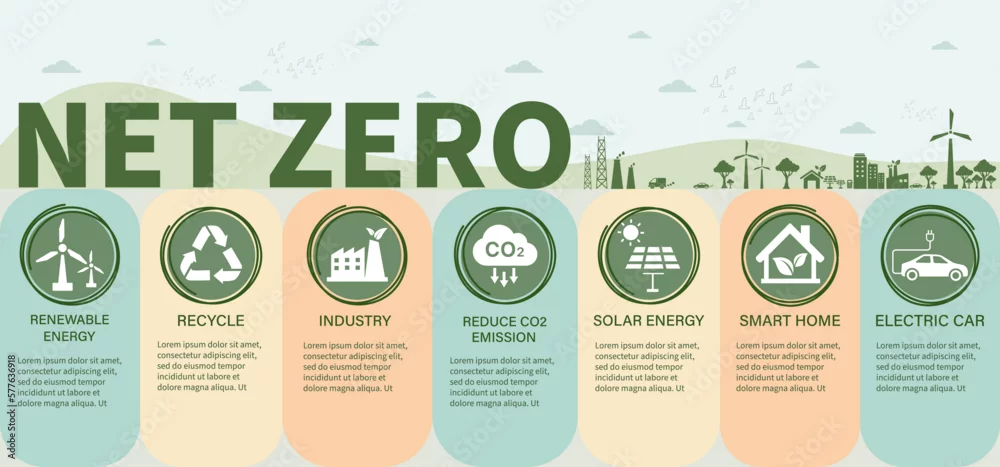
Here is a breakdown of the debate, structured around the “Possible vs. Probable” framework.
The Net Zero Debate: Possible vs. Probable
1. Why It Is TECHNICALLY Possible (The Optimist’s View)
Experts, including the Intergovernmental Panel on Climate Change (IPCC) and the International Energy Agency (IEA), have mapped out pathways that show the target of reaching Net Zero by 2050 is technically feasible.
- Cost-Competitive Renewables: Solar and wind power are now the cheapest sources of electricity in most parts of the world, making the energy transition economically viable in the long run.
- Decarbonization Technologies: For the majority of sectors, the technology needed to reach near-zero emissions already exists:
- Power: Wind, solar, hydro, and nuclear (including new small modular reactors, or SMRs).
- Transport: Electric Vehicles (EVs) for road transport are mature.
- Buildings: Heat pumps and insulation for efficient heating and cooling.
- Carbon Removal (The “Net” in Net Zero): While direct emissions cuts are primary, the remaining “hard-to-abate” sectors (like aviation, shipping, heavy industry) can be offset by Carbon Dioxide Removal (CDR) methods, such as reforestation or nascent Direct Air Capture (DAC) technologies.
Key Finding: The IEA’s “Net Zero by 2050 Roadmap” proves a pathway exists, but it is “narrow and extremely challenging.”
2. Why It Is NOT Currently Probable (The Realist’s Challenge)
The primary barriers are rooted in economics, policy, and human behavior. Current action is not keeping pace with the technical requirements.
| Barrier | Description | Required Action for Net Zero (IEA/UN) |
| Pace of Transition & Investment | The current linear rate of clean energy adoption is too slow. The world is on track for $2.6^\circ\text{C}$ of warming, not $1.5^\circ\text{C}$. | Global annual energy transition investment must increase by $\sim$30% (to over $4$ trillion USD annually) and be strategically deployed to the right sectors. |
| “Hard-to-Abate” Sectors | Industries like cement, steel, chemicals, shipping, and aviation rely on processes that are technologically difficult or prohibitively expensive to electrify or convert to green hydrogen/biofuels today. | Massive R&D and large-scale pilot projects are needed immediately to bring these costly green technologies down the cost curve (e.g., green hydrogen production must expand fourfold by mid-century). |
| Policy and Political Will | Global cooperation is hindered by geopolitical tensions, domestic policy inconsistencies, and resistance from regions dependent on fossil fuel revenue. | Governments must establish strong, stable, and binding regulation that sends clear long-term signals to the private sector to de-risk investment. |
| Grid and Storage Infrastructure | Scaling up intermittent renewable energy sources (wind/solar) requires a complete, costly, and time-consuming overhaul of electrical grids and a massive deployment of long-duration energy storage solutions. | Rapid deployment of battery storage and massive upgrades to transmission lines to ensure energy is always available, regardless of the weather. |
| Equity and Development | Developing economies face a dual challenge: addressing poverty and rapidly decarbonizing. They require significant financial and technological transfers from wealthy nations (who are historically responsible for most emissions). | Developed nations must fulfill their climate finance pledges and provide concessional financing to support clean energy expansion in developing regions, rather than deepening global inequality. |
The Crucial Ambiguity: “Net” vs. “Absolute” Zero
A major critique of the goal is the term “Net Zero,” which allows for a small amount of residual emissions to be balanced by carbon removal. Critics argue this creates a dangerous loophole:
- Risk of Procrastination: Companies and countries may rely on the promise of future, large-scale, and currently unproven CDR technologies (like DAC) instead of making difficult, costly cuts to fossil fuel consumption now.
- Low-Credibility Targets: Many corporate and national targets lack credibility, having vague plans for the majority of cuts and over-relying on cheap, low-quality carbon offsets.

Good approach related to carbon neutralization.