
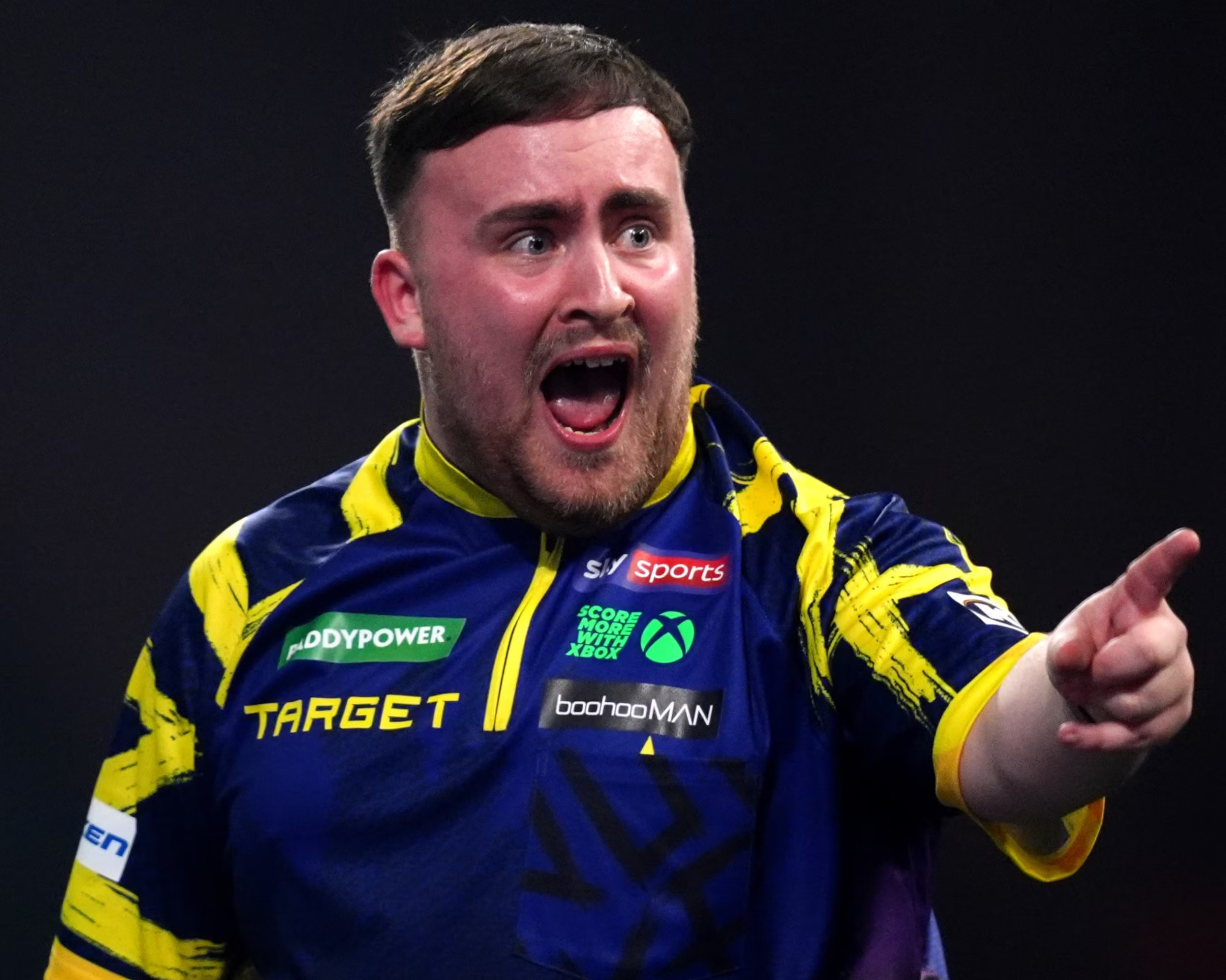
High-level sport possesses an intrinsic dramaturgy that often exceeds the mere framework of athletic competition. At Alexandra Palace (the historic temple of darts in London), we are currently witnessing a fascinating narrative shift. Luke Littler, who won hearts at 16, must now deal with increasing hostility as he attempts to retain his world title at 18. His tense 4-2 victory over Rob Cross this Tuesday, December 30, 2025, marks a definitive turning point in his career.
An Electric and Hostile Atmosphere at Alexandra Palace
The popular adage suggests that one either dies a hero or lives long enough to become the villain of the story. For Littler, this transition happened in the blink of an eye. The Ally Pally crowd, once protective of the young teenager, seems to have adopted a confrontational stance. During the match against Cross, every missed double (the outer segment of the target that allows a leg to be finished) was greeted with ironic cheers, while chants for his rivals echoed through the hall.
This dynamic of sport psychology (the study of how psychological factors affect performance) is essential to understanding Littler’s resilience. Far from collapsing under the pressure of the boos, the young champion seems to draw new energy from this adversity. His final reaction, screaming “NOW WHAT?” at the crowd after sealing his victory, testifies to a fierce, albeit polarizing, competitive maturity.
The Rise of the “Villain”: An Involuntary Branding Strategy?
Littler’s post-match attitude recalled that of other polarizing figures in contemporary British sport, such as Jude Bellingham or Tyson Fury. By boldly stating that the crowd’s boos were merely financing his prize money, Littler is fully embracing his new role.
A Champion’s Reaction to the Boos
It is interesting to note that this hostility does not necessarily stem from a dislike of his talent, but rather from a weariness of his dominance. The public of the Professional Darts Corporation (the global organization that manages the professional circuit) is known for its versatile character. Many spectators are now “cultural tourists” looking more for the spectacle than pure technical performance.
For Littler, the challenge is now to manage what sociologists call the “Streisand effect”: the more he reacts to provocations, the more the public will be inclined to boo him to get a reaction. However, on a purely statistical level, this tension seems to act as a catalyst.
Technical Analysis: Why Littler Remains the Favourite
Despite a toxic environment, the level of play displayed by the world number 1 remains stratospheric. For technical observers, Littler’s performance against Rob Cross was not just a mental victory, but a demonstration of raw strength.
- Scoring Average: Littler maintained an average of 107 points per visit (the average score obtained with three darts).
- Initial Precision: On his first nine darts, his average rose to 117, putting constant pressure on his opponent from the start of each leg.
- Stress Resistance: In the third set, he reached an exceptional average of 125.
The Duel Against Rob Cross: A Decisive Turning Point
Rob Cross, the 2018 world champion, did not demerit. He pushed Littler to his limits, taking advantage of every hesitation from the young prodigy to stay in touch. At 3 sets to 2, Cross even had an opportunity to equalize. It was at this precise moment that Littler produced what experts call a “break” (winning a leg when the opponent started throwing first), by performing a near-perfect sequence of 140-180-141. This ability to produce a nine-dart finish (the perfect score to finish a 501-point leg) or come close to it under such pressure is the mark of the greats.
The Rest of the Bracket: Towards a Second Consecutive Title?
The path to the final now seems clear, although the psychological pitfalls are numerous. Littler will face Luke Woodhouse or Krzysztof Ratajski in the quarter-finals on New Year’s Day. According to the darts betting odds (the probabilities of victory estimated by bookmakers), he remains the massive favourite to retain his title.
In the other part of the tournament bracket (the structure organizing the successive confrontations), players like Ryan Searle are showing impressive form, having not yet lost a single set. The potential semi-final confrontation could offer a striking contrast in styles between Searle’s calm and Littler’s combative exuberance.
In conclusion, Luke Littler is no longer the little boy England wanted to protect. He has become an accomplished athlete, aware of his value and ready to defy conventions to make history in his sport. Whether loved or booed, his trajectory remains the hottest topic in sports news at the start of 2026.
