
Foldable Innovation Reaches its Zenith
In the ultra-competitive world of mobile technology, innovation is the only true currency. Samsung Electronics, a pioneer in foldable smartphones since 2019, has just taken a decisive step with the launch of its highly anticipated triple-screen model: the Galaxy Z TriFold. This new device, positioned as a flagship product of the next generation, is not only a feat of engineering; it represents the South Korean giant’s response to the intensifying competition, particularly from dynamic Chinese brands like Huawei and Honor.
While the foldable smartphone market, though still a niche, continues to expand, the expected entry of Apple promises to reshuffle the deck. With the Galaxy Z TriFold, Samsung seeks to assert its technological supremacy and test the limits of portability and productivity. This launch, starting in South Korea before extending to key markets, is a bold bet on the future of mobile devices. We will explore the unique features of this flagship, the competitive challenges it addresses, and what this “multi-fold pilot” means for the evolution of personal devices.
The Anatomy of a Revolution: The Galaxy Z TriFold Under the Microscope
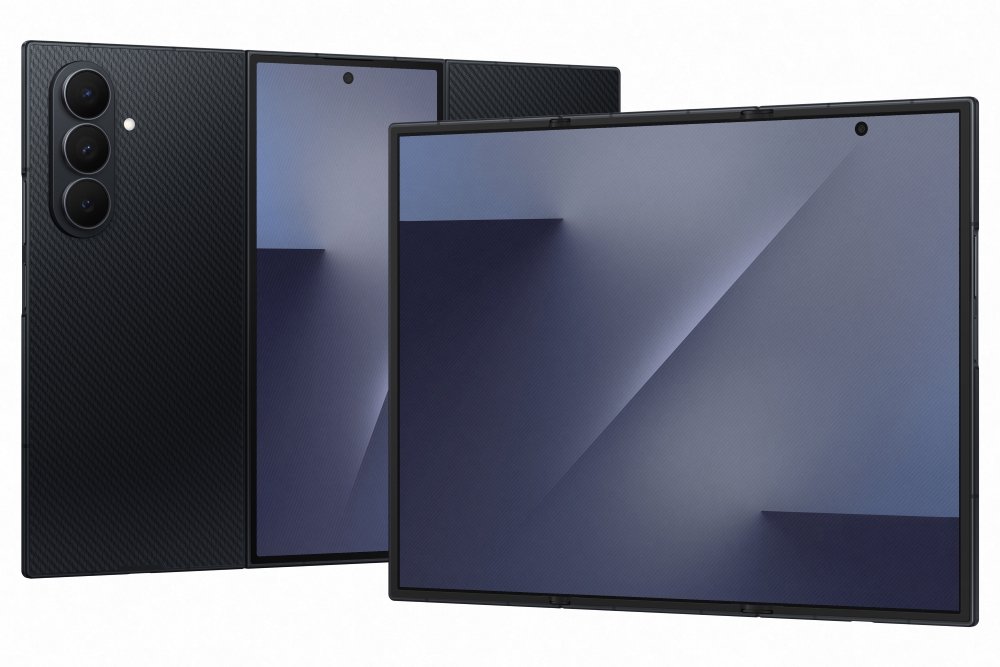
The Galaxy Z TriFold is not a simple evolution; it is a fundamental redesign of the foldable smartphone concept. The shift from two to three panels and two inward-folding hinges propels it into a new category of hybrid devices.
A 10-Inch Inner Display: The Tablet Experience
The main appeal of the TriFold lies in its massive unfolded inner screen. Thanks to its two inward-folding hinges, the device opens to reveal a 10-inch display (about 25.4 cm diagonally), with a resolution of 2160 x 1584 pixels. Although slightly smaller than the 11-inch display of the 11th-generation iPad, this workspace positions it directly as a credible tablet substitute.
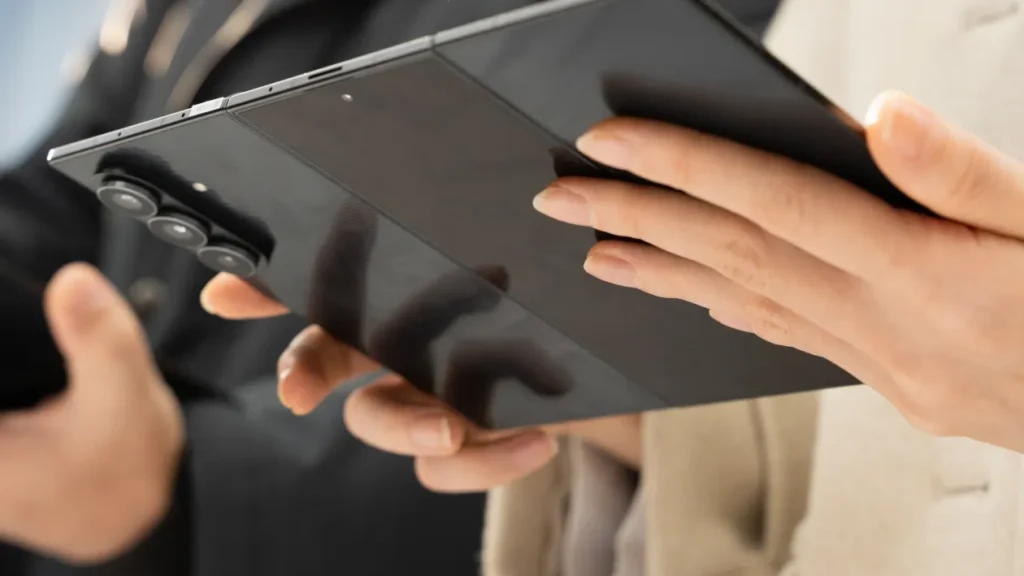
This expanded display area is essential for productivity and multitasking, a major focus of Samsung’s strategy. The three foldable panels can simultaneously run three apps side by side vertically, allowing for a desktop-like mode without the need for a separate display or dedicated mode. As pointed out by TM Roh, recently appointed co-CEO of Samsung Electronics and Head of the Device eXperience division, the TriFold reflects years of work aimed at balancing portability, performance, and productivity.
Design, Durability, and Technical Specifications
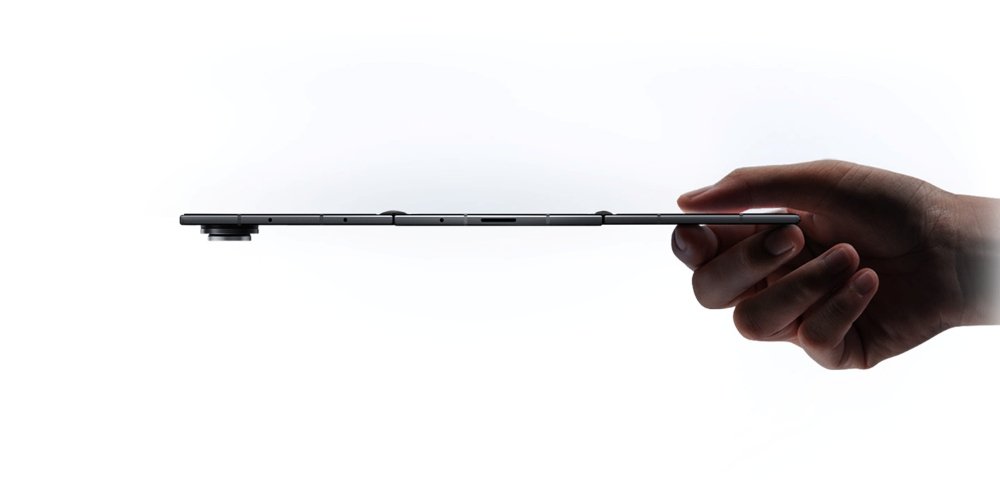
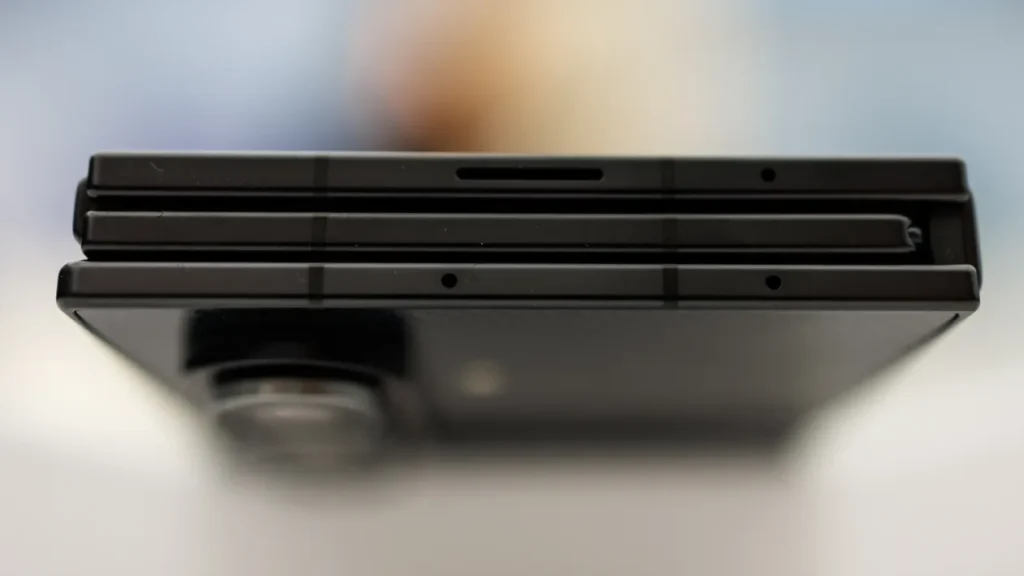
Despite the addition of a panel, the device’s design remains relatively compact. The thickness of the TriFold when folded is 12.9 millimeters (0.5 inches). This makes it slightly thicker than the Galaxy Z Fold6 (12.1 mm) but more substantial than the latest Galaxy Z Fold7 (8.9 mm), attesting to the technical challenges associated with integrating a third section.
In terms of power, the TriFold will launch as a single model in black, equipped with 16GB of memory and 512GB of storage.
Regarding durability, the TriFold is rated IP48, a standard Samsung has adopted for its recent foldable models. This means it is water-resistant up to 1.5 meters for 30 minutes (similar to IPX8), but offers only limited dust protection (the “4” in the IP48 rating). Improving dust resistance remains the major challenge for all foldable phone manufacturers.
Finally, the device features Samsung’s largest battery capacity among its foldable models and supports super-fast charging, reaching 50% in 30 minutes.
Competitive Stakes: Pioneering Innovation Against Asia
The launch of the TriFold comes at a time when the competitive landscape of foldable phones is heating up rapidly. Samsung was the early innovator with its first foldable device in 2019, but other players have caught up, and in some aspects, even surpassed Samsung’s design.
Intensification of Chinese Competition
The most significant pressure comes from Chinese brands, which have been aggressive in pricing and dimensional innovation. Huawei: In September, the telecommunications giant Huawei announced its own second-generation trifold phone for the Chinese market. Notably, this model is slightly thinner than Samsung’s TriFold, measuring 12.8 mm thick when folded. Honor: Other brands, such as Honor (which was spun off from Huawei in 2020 to avoid U.S. sanctions and enter international markets), are also launching foldable smartphones globally, intensifying the battle for market share. These competitors not only force Samsung to continually innovate but also threaten its dominance by offering highly competitive products.
Anticipating Apple: The Leadership Test
The other major strategic threat is the expected entry of Apple into the foldable segment. Liz Lee, Associate Director at Counterpoint Research, clearly stated the challenge: “With Apple’s expected entry into the foldable segment, Samsung is positioning this device as a multi-fold pilot to reinforce its technology leadership.”
The Galaxy Z TriFold, although initially released in very limited volume, is intended to gather real-world user insights on durability, hinge design, and software performance before wider commercialization. It serves as a technology laboratory aimed at preparing Samsung’s next wave of foldable products for 2026, when the competitive dynamic is expected to be “materially shifted” by Apple’s arrival.
Price and International Launch Schedule
The pricing of the TriFold reflects its status as a niche product and technological luxury. The launch price in South Korea is set at 3,594,000 South Korean won, which equates to approximately $2,449 US dollars.
The international rollout is strategically phased: South Korea: Sales start on December 12, 2025. Asia/Middle East: Rapid launch in key markets such as China, Taiwan, Singapore, and the United Arab Emirates. United States: Availability is planned for the first quarter of 2026. This schedule shows that Samsung seeks to quickly capitalize on its Asian and Middle Eastern markets, while the US launch is staggered, potentially allowing for the integration of initial user feedback.
Samsung’s Three-Fold Future
The launch of the Galaxy Z TriFold is more than just a product announcement; it is a manifesto from Samsung asserting that its future lies in flexibility and modularity. By integrating a 10-inch display, superior multitasking capability, and an optimized battery, the TriFold offers a hybrid experience that could redefine the personal device category.
Faced with increasing pressure from Chinese brands and the imminent arrival of Apple, this “multi-fold pilot” is Samsung’s strategy to solidify its position as a technology leader. The success of the TriFold will not be measured by its initial sales volume, but by the richness of the data it provides for future generations of foldable smartphones, ensuring that Samsung remains at the forefront of the mobile revolution.
