
The meteoric rise of Francis Bourgeois, the TikTok trainspotter (a platform for sharing short videos), has been one of the most refreshing stories in the recent British media landscape. With his boundless enthusiasm and distorting head-cam, he has managed to turn trainspotting into a pop culture phenomenon. However, his latest project, Mission to Space with Francis Bourgeois, broadcast on Channel 4, forces us to ask a fundamental question: can the charm of an authentic amateur survive the rigid constraints of a 90-minute documentary format?
A Leap into the Unknown: From Locomotives to Rockets
The premise of the documentary is simple, albeit a bit far-fetched: Francis Bourgeois, an engineering graduate, has always dreamed of space. The show attempts to answer a question: can a civilian, no matter how passionate, become an astronaut?
From the very first minutes, the answer seems unfortunately obvious. The production seems to have confused Francis’s intellectual curiosity with the extraordinary physical and psychological capacities required for space exploration (the study and travel into deep space). Although his erudition in rail mechanics is undeniable, the transition to the rigors of NASA and Axiom Space (a private company developing commercial space stations) proves to be a leap too far.
The Ordeal of Aerospace Medicine
One of the most striking — and painful — segments takes place at the center for aerospace medicine (the medical specialty studying human health in space). Francis meets a national icon: Major Tim Peake. The goal is to test the young man’s resistance to centrifugal force (a force that pulls an object outward when it rotates around a center).
The G-Force Test Failure
Bourgeois, with his usual frankness, admits to losing consciousness if he stands up too quickly. What follows is predictable: as soon as the centrifuge is started, Francis passes out. This moment, although filmed with a certain empathy, highlights the cruelty of the concept. We are no longer watching a young man live his dream, but an amateur pushed beyond his biological limits for the sake of ratings.
Hypoxia and Motion Sickness
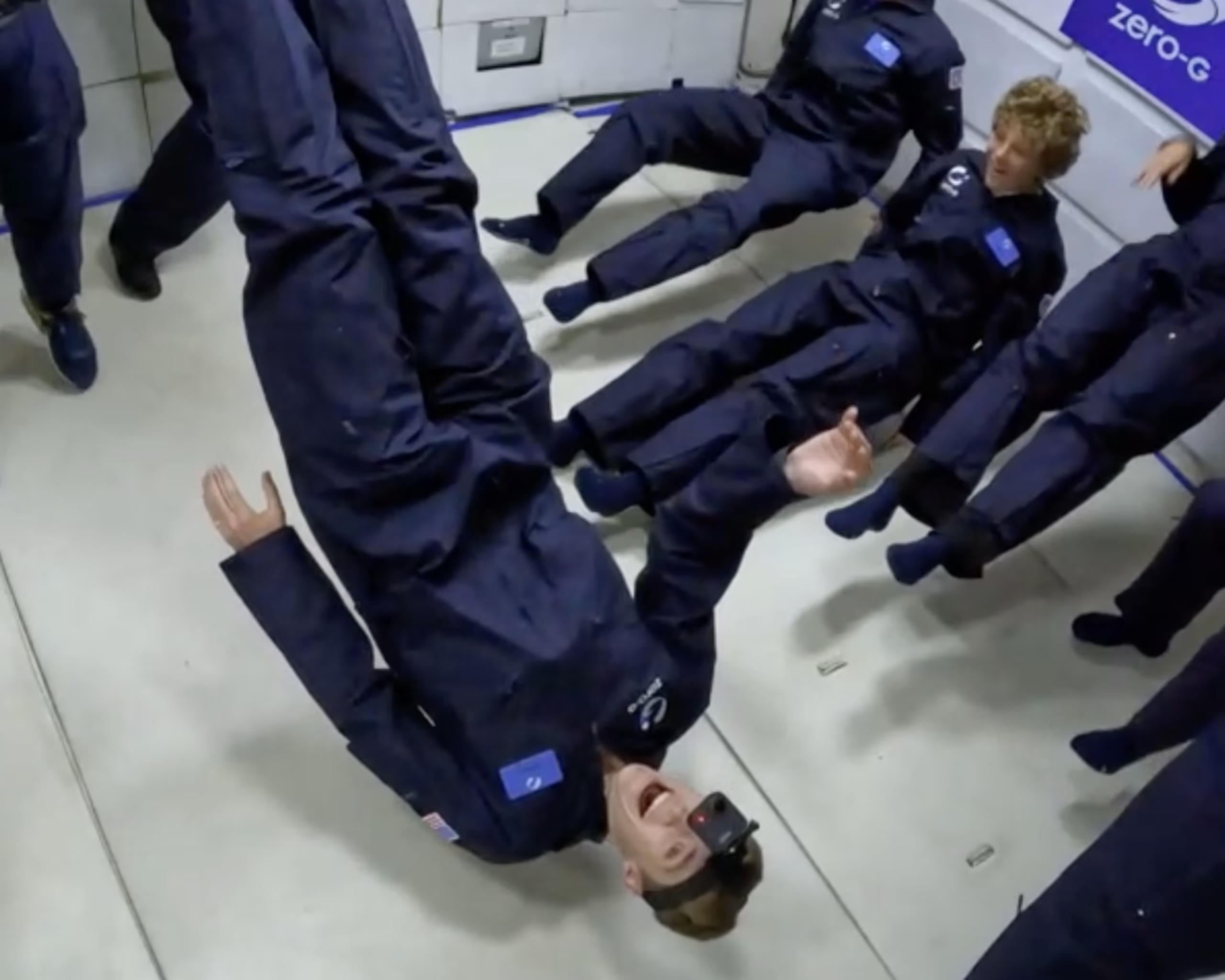
The journey continues in the United States, where Francis undergoes tests for resistance to hypoxia (a decrease in the amount of oxygen delivered by the blood to the tissues). Again, his capabilities are judged negligible. The climax of this discomfort occurs during a parabolic flight (a flight simulating weightlessness by performing specific curves), where poor Francis is violently sick in zero gravity. Seeing this influencer, usually so radiant, reduced to a state of physical distress raises a question: was this voyeurism really necessary?
A Documentary Format in Search of Meaning
The main flaw of Mission to Space lies in its structure. Divided into two 45-minute episodes, the program drags on unnecessarily. Where a shorter format could have captured the essence of discovery, these 90 minutes end up weighing on the viewer.
A Sometimes Forced Narrative
The intervention of Sir Stephen Fry, who provides narration with an almost exhausting brio, tries to give a lyrical dimension to the adventure. However, this creates a dichotomy (a separation between two opposing elements) between Francis’s down-to-earth simplicity and the grandiloquence of the script.
Attempts to add emotional depth, notably through a session with a therapist to discuss the sacrifice of leaving loved ones (and his cat) behind, fall flat. It feels like the subject himself, Francis, is more comfortable talking about valves and pressure than his existential anxieties regarding the void of space.
Space Engineering: Francis’s True Playground
It is in the final fifteen minutes that the documentary finally finds its way. When Francis sheds the astronaut suit for that of an engineer, the spark returns. By talking with the technicians who design the components of future orbital stations, he finds his natural language again.
Space engineering (the design and construction of vehicles and equipment for space) seems to be his true area of expertise. When he marvels at the complexity of a valve, his enthusiasm is once again infectious. This is where Francis Bourgeois’s true value lies: his ability to popularize technical concepts with a childlike joy.
In conclusion, while Mission to Space shows us that he is not made for a rocket cockpit, it confirms that Francis remains an outstanding communicator. We simply hope that his future adventures will better respect his gentle nature and intellect, rather than trying to break him in a centrifuge.
