
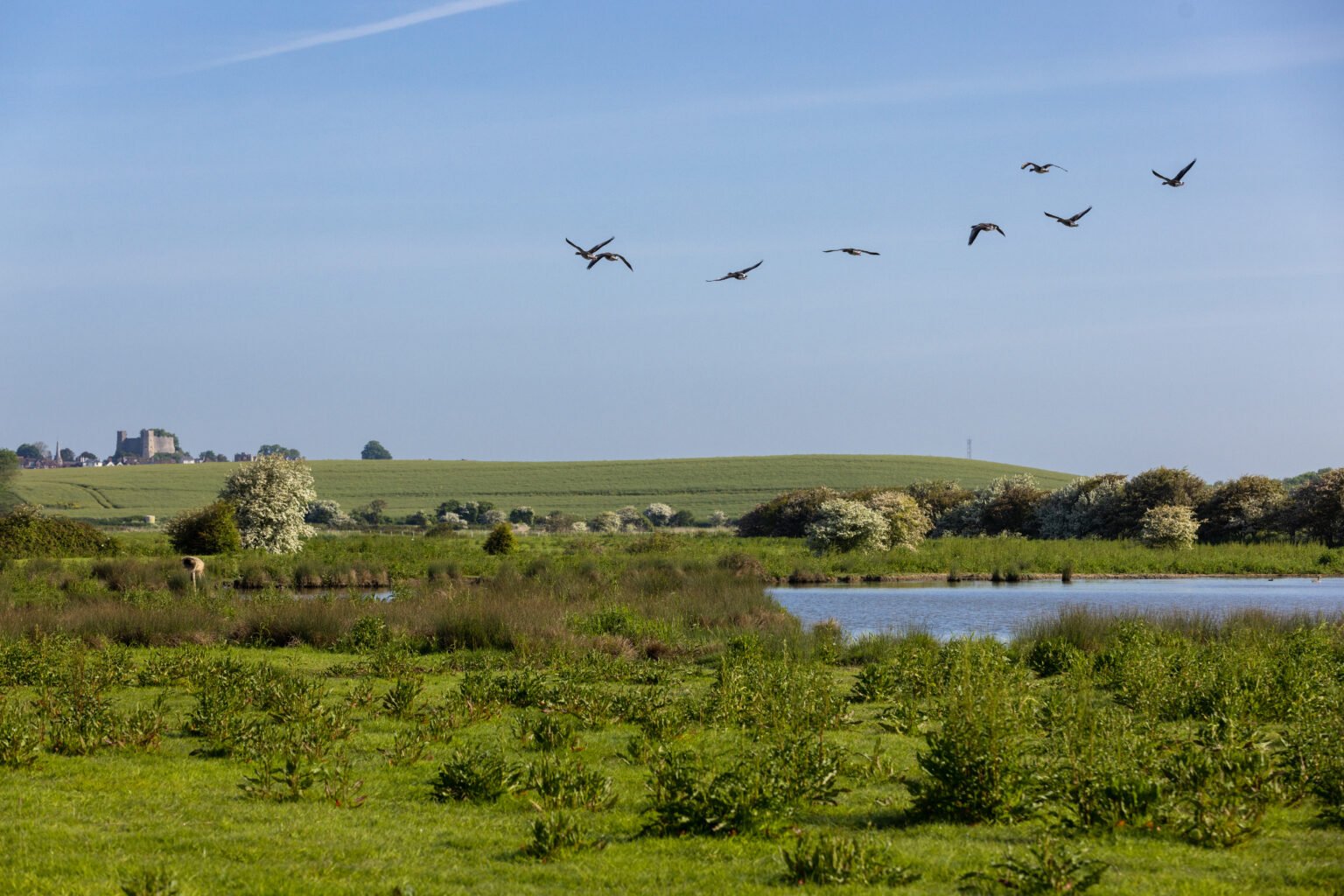
The UK’s strategy is complex, involving legal mandates, financial incentives for land managers, and specific targets for habitat restoration.
1. Statutory Framework and Key Targets (England Focus)
The most significant recent policy is the Environment Act 2021, which established legally binding targets for nature recovery in England, aiming to halt the decline of species abundance.
| Target Area | 2030 Goal | 2042 Goal | Key Mechanism |
| Species Abundance | Halt the decline in species abundance by 2030. | Achieve a 10% increase in species abundance compared to 2030 levels. | Data collection, Local Nature Recovery Strategies |
| Habitat Restoration | Restore or create over 500,000 hectares of wildlife-rich habitat outside protected sites. | Environmental Land Management Schemes (ELMs), BNG | |
| Protected Sites | Protect 30% of UK land and sea (the “30×30” commitment). | Ensure 70% of protected sites (like SSSIs) are in favourable condition. | Strengthening protected site management |
| Woodland Cover | Increase total tree and woodland cover to 16.5% of land area by 2050 (from 14.5%). | Large-scale tree planting and reforestation efforts |
Mandatory Biodiversity Net Gain (BNG)
A cornerstone of the Environment Act is the mandatory Biodiversity Net Gain requirement for all new developments in England.
Key Feature: Developers must demonstrate that their project will result in a minimum of 10% increase in biodiversity value on or near the site, maintained for at least 30 years.
Significance: This fundamentally shifts the planning system from simply mitigating harm to requiring an overall positive contribution to nature.
2. Policy Delivery and Funding Mechanisms
The UK is implementing several major schemes to drive change across the landscape:
- Environmental Land Management Schemes (ELMs): This is the new system replacing EU Common Agricultural Policy subsidies. It pays farmers and land managers in England for delivering environmental public goods, such as improving biodiversity, restoring peatland, and reducing flood risk. This is crucial, as agriculture occupies over 70% of UK land.
- Local Nature Recovery Strategies (LNRSs): These are being developed across England to map out local nature priorities and opportunities. They are intended to create a cohesive Nature Recovery Network, helping to connect fragmented habitats and allowing species to move and thrive.
- Rewilding and Reintroductions: High-profile successes include the reintroduction of Beavers (nature’s engineers that create biodiverse wetlands and mitigate flooding) and the continued return of species like the White-Tailed Eagle and the Large Blue Butterfly.
3. Key Challenges and Progress
While the policy framework is ambitious, the UK faces significant challenges:
| Challenge Area | Description | Current Status of Nature |
| Historical Decline | The UK is often described as one of the most nature-depleted countries on Earth, with significant losses since the Industrial Revolution. | 16% of the UK’s species are at risk of being lost, and the abundance of all UK species has declined by an average of 19% since 1970 (State of Nature Report). |
| Implementation Lag | Many new policies (like ELMs and BNG) are complex, still in their early phases of rollout, and have not yet delivered results at scale. | The environmental watchdog, the Office for Environmental Protection (OEP), has warned that the prospects of meeting key targets are currently “largely off track.” |
| Pollution & Intensification | Intensive farming practices, nutrient pollution from agriculture, and sewage discharges continue to exert immense pressure on UK rivers, waterways, and soil health. | Only 14% of the UK’s most important habitats are in a good ecological state. |
| Devolved Policy | Nature conservation is a devolved responsibility. While England, Scotland, Wales, and Northern Ireland share core ambitions (like the 30×30 goal), their specific strategies, targets, and delivery mechanisms differ, requiring constant coordination. |
The overall approach is a shift towards nature-based solutions and embedding environmental protection within the economy and spatial planning.
