
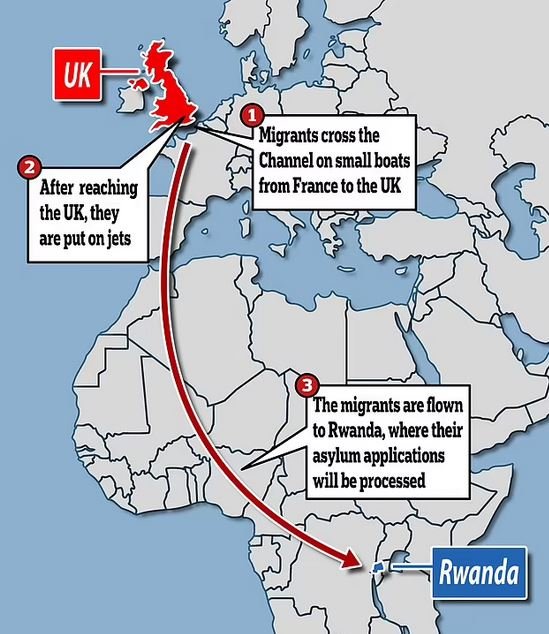
The UK’s immigration policy concerning unauthorized arrivals, particularly via small boats across the English Channel, has undergone a fundamental transformation in 2025. The shift is defined by the cancellation of the controversial Rwanda plan and the establishment of a new domestic enforcement strategy aimed at disrupting human trafficking networks.
This article details the current status of the policies, the ongoing challenge of small boat crossings, and the new government’s approach to the asylum system.
I. The Cancellation of the Rwanda Scheme
The proposed policy—the Migration and Economic Development Partnership with Rwanda—aimed to deter asylum seekers arriving via irregular routes by forcibly relocating them to Rwanda for processing and settlement.
- Political Reversal: Following the 2024 General Election, the new UK government officially confirmed its intention to scrap the Rwanda scheme, deeming it an ineffective and expensive deterrent. This move effectively brought an end to a policy that had been a central pillar of the previous government’s immigration strategy.
- Legal Resolution: As a direct consequence of the policy’s cancellation, ongoing legal challenges, including those lodged with UK courts and the European Court of Human Rights (ECtHR), have been withdrawn. The government has introduced the Border Security, Asylum and Immigration Bill (introduced in February 2025) to formally repeal the key legislation, including the Safety of Rwanda (Asylum & Immigration) Act 2024.
- Financial Cost: Despite no asylum seekers ever being forcibly relocated under the scheme, the financial outlay was substantial. The cancellation saves the UK from further millions in anticipated payments to Rwanda, with reports noting over £300 million was committed or paid out before the policy was officially abandoned.
- No Deterrent Effect: The scheme failed to demonstrate a deterrent effect. Figures showed that nearly 84,000 people arrived via small boats between the announcement of the partnership in April 2022 and the July 2024 election.
II. The Ongoing Challenge of Channel Crossings
Despite the change in government and policy, the fundamental issue of small boat arrivals across the English Channel remains a critical humanitarian and political challenge.
1. Statistical Overview (Year Ending June 2025)
Irregular arrivals have continued at significant levels, placing immense strain on the UK’s asylum and accommodation system:
- Total Arrivals: In the year ending June 2025, there were 43,309 people detected arriving on small boats, a 38% increase compared to the previous year and only 5% fewer than the peak recorded in 2022.
- Nationalities: Over half (55%) of the detected arrivals were from just five nationalities: Afghans, Eritreans, Iranians, Sudanese, and Syrians. This trend reflects ongoing global conflicts and humanitarian crises, with Afghan nationals being the most common group.
- Boat Capacity: Trafficking gangs are increasingly using larger vessels, with the average number of people per small boat rising to 56 in the year ending June 2025 . This highlights the increasing danger of the crossing and the sophisticated nature of the organized criminal networks involved.
2. The New Enforcement Strategy: Border Security Command
The new government has replaced the Rwanda policy with a strategy focused on domestic enforcement and international collaboration:
- Border Security Command (BSC): This new agency is being established with the explicit mandate to disrupt and dismantle human smuggling gangs. The BSC is designed to integrate the capabilities of the Home Office, law enforcement, and security services, using sophisticated intelligence and new counter-terrorism powers to target traffickers both in the UK and internationally.
- International Cooperation: The primary emphasis is on strengthening collaboration with European partners, particularly France, to intercept boats before they leave French shores and to target the supply chains of the criminal networks operating across the continent.
III. The Future of Asylum Processing
With the deterrent policy shelved, the focus is now on fixing the underlying inefficiencies in the asylum system.
- Backlog and Costs: Years of backlogs mean tens of thousands of asylum seekers remain in limbo, accommodated in temporary facilities (such as hotels) at an enormous cost to the taxpayer. The new strategy prioritizes clearing the backlog to reduce these costs and offer certainty to applicants.
- The Illegal Migration Act (IMA): While the Rwanda Act is being repealed, the status of the broader Illegal Migration Act 2023 remains complex. The IMA aimed to make asylum claims inadmissible for anyone arriving via an irregular route. The current government is modifying parts of this Act to ensure compliance with human rights obligations, transforming what was an unworkable duty into a power to declare claims inadmissible, which must be exercised lawfully.
The UK’s immigration policy is thus entering a phase defined by practical, operational fixes rather than large-scale, politically controversial deterrents. The effectiveness of the new Border Security Command and international cooperation will be the key metrics for success in managing Channel crossings in the years ahead.
You can learn more about the number of migrant arrivals in the UK via small boats in 2025 by watching UK Sees Nearly 50% Surge in Migrant Arrivals by Small Boats in 2025.

Good plan .It is too important