
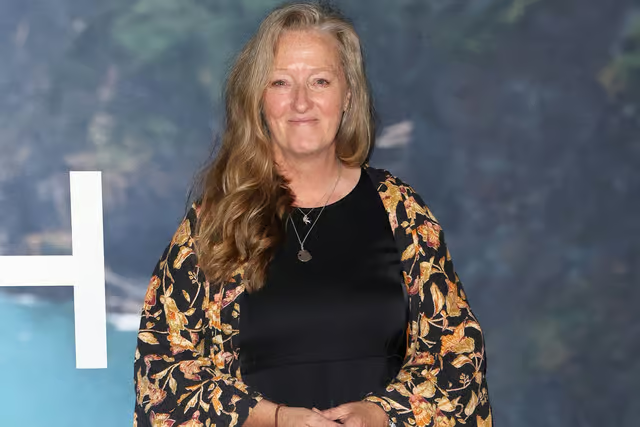
The literary world in the UK is currently gripped by a developing story that challenges the narrative of one of the most beloved books of the last decade. Raynor Winn’s The Salt Path, a memoir that sold over two million copies and inspired a major film starring Gillian Anderson, is under intense scrutiny. This weekend, the newspaper The Observer published further claims questioning the veracity of the author’s account, sparking a heated debate about memoir authenticity. Here is a deep dive into the situation.
The Story That Captivated a Nation
To understand the weight of this Raynor Winn controversy, one must first look at the cultural impact of the book. Published in 2018, The Salt Path told the harrowing yet inspiring story of Raynor and her husband, Moth. According to the book, the couple lost their home following a bad business investment just days after Moth was diagnosed with a terminal illness known as Corticobasal Degeneration (CBD).
Facing homelessness and despair, they decided to walk the 630-mile South West Coast Path. The narrative is one of redemption, nature’s healing power, and defiance against a medical death sentence. It resonated deeply with readers, cementing itself as a modern classic of nature writing.
The Observer’s Bombshell Investigation
The fairy tale narrative began to fracture in July 2025, and cracks have widened with new reports published this December. The Observer has launched a series of accusations that fundamentally challenge the two main pillars of the book’s plot: the financial ruin and the medical diagnosis.
Financial Discrepancies
In the memoir, the loss of their farmhouse is attributed to a failed business deal with a friend. However, the newspaper alleges a darker reality. Their investigation suggests the couple lost their home following accusations that Winn had misappropriated funds from a former employer. This allegation of financial misconduct paints a very different picture of the “innocent victims” narrative presented in the bestseller.
Medical Skepticism
Perhaps the most sensitive aspect of the literary scandal concerns Moth’s health. In the book, Moth suffers from Corticobasal Degeneration (CBD), a rare, progressive neurological disorder that affects walking, balance, and swallowing. The Observer cites medical experts who have expressed skepticism regarding Moth’s condition as described.
These experts point out the lack of acute symptoms typically associated with the late stages of this disease and question his apparent ability to reverse the condition through walking—a medical impossibility for a degenerative disease. This has led to uncomfortable questions regarding the Moth Winn health condition and whether the severity of the illness was embellished for dramatic effect.
Raynor Winn’s Defense
Facing what she calls the “hardest days” of her life, Raynor Winn has vehemently denied the accusations. She has taken to social media and her website to defend the The Salt Path accuracy.
In a bid to silence the critics, Winn posted clinic letters on Instagram addressed to Timothy Walker, which she claims prove that Moth has been treated for CBD/S (Corticobasal Syndrome) for years. In an emotional statement, she wrote:
“The Salt Path is about what happened to Moth and me… It’s not about every event or moment in our lives, but rather about a capsule of time when our lives moved from a place of complete despair to a place of hope.”
She argues that the newspaper’s investigation is “grotesquely unfair” and seeks to pick apart a narrative that was meant to capture an emotional truth rather than a forensic accounting of every life event.
Publisher’s Stance and Future Implications
Penguin, the publishing house behind the hit, has stated that it performed all necessary “due diligence” (a comprehensive appraisal of a business or person prior to signing a contract) before publication. They noted that no concerns were raised prior to The Observer’s inquiry.
However, the damage to the book’s reputation could be significant. Memoirs exist on a fragile contract of trust between author and reader. While artistic license is expected, fabricating the core causes of the story’s conflict-the reason for homelessness and the nature of a terminal illness-crosses a line for many. As The Observer investigation continues, fans are left torn between the inspiration the book gave them and the unsettling possibility that they were misled.
